Private label
The manufacturer has a catalogue of formulas already developed and tested for stability and safety. You choose the formula, the packaging and the design, and the product goes out under your brand. We offer more than 300 ready formulas.
Private label vs contract manufacturing
Private label and contract manufacturing are two ways of having cosmetics made under your brand without a plant of your own. The main difference is the formula: ready-made in the first case, developed for you (or already yours) in the second. Either way, with us you start from 500 units per product.
In the cosmetics industry, “private label”, “contract manufacturing” and “white label” are often used as if they meant the same thing. They don’t quite, and understanding the difference helps you read quotes and contracts.
The manufacturer has a catalogue of formulas already developed and tested for stability and safety. You choose the formula, the packaging and the design, and the product goes out under your brand. We offer more than 300 ready formulas.
The manufacturer makes a product to your specification: it develops a custom formula from your brief, or produces a formula you already own. The lab works for you and the product carries your name. You may also see it called OEM or toll manufacturing.
Strictly speaking, a finished product that is identical for every client, to which you only add your brand, often on a standard label or pack. Many suppliers use “white label” to mean private label, so always ask what you can actually personalise.
This is the most important question, because it decides what happens if you ever change supplier.
With us, confidentiality starts before the project does: we sign a non-disclosure agreement (NDA) before receiving your information. Custom formulas can be exclusive to a single client, and exclusivity on a formula is available on request. For wholesalers and distributors, exclusivity by territory or channel can also be agreed, with conditions set case by case.
With a catalogue formula, another brand may sell the same product under a different name. For many projects that isn’t a problem: buyers choose your brand, your packaging, your channel. It becomes a problem when:
In these cases a custom formula, or exclusivity on an existing formula, is the better choice.
There is no single price: it depends on the product, packaging, design and quantity. But the cost items change in predictable ways between the two models.
No formula development costs. Samples are available straight away, because the formula already exists. The safety documentation starts from an established base. It is the route with the smallest initial investment.
Development is added: brief, lab trials, samples in about 2 weeks, any changes. Stability tests may be needed and, if you want to communicate an effect, dedicated efficacy tests. It costs more at the start, but the product is yours alone.
In both cases delivery takes 4–6 weeks from order confirmation, which comes after samples, packaging and artwork are approved. You will find each cost item in our guide to the cost of starting a cosmetic line.
| If… | The better choice is |
|---|---|
| you want to launch quickly on a limited budget | private label with a ready formula |
| you want to test the market with a few products | private label, 500 units per SKU |
| you sell online and worry about identical products | custom formula or exclusivity |
| you already own a formula | contract manufacturing of your formula |
| you want a specific claim (for sensitive skin, for example) | custom formula with dedicated tests |
| you want a product nobody else can sell | exclusive custom formula |
Many brands combine the two: they launch with some ready formulas and add a custom formula once the line is selling. It is a path we see often in the projects we follow.
The model you choose doesn’t change your legal obligations or the quality of production.
Whichever model you choose, before you sign ask the manufacturer:
Clear answers are the first sign of a reliable partner.
With private label you choose one of the manufacturer’s ready formulas and personalise it with your brand. With contract manufacturing the manufacturer develops a formula to your brief or produces a formula you already own.
They are often used interchangeably. Strictly, white label is a product identical for everyone to which you only add your brand, whereas with private label you also choose the packaging and design.
Yes, on request. We discuss it during the assessment phase, because exclusivity depends on the formula and the project.
The first samples arrive in about 2 weeks. Once samples, packaging and artwork are approved, delivery takes 4–6 weeks from order confirmation.
No, we start from 500 units per SKU in both cases. An SKU is one product in one format.
Yes. You can start with ready formulas and develop a custom formula once you know your customers better; your brand and artwork stay yours. See how custom formulation works.
Tell us about your project: we reply within one hour, and a project manager helps you decide whether to start from a ready formula or a custom one.
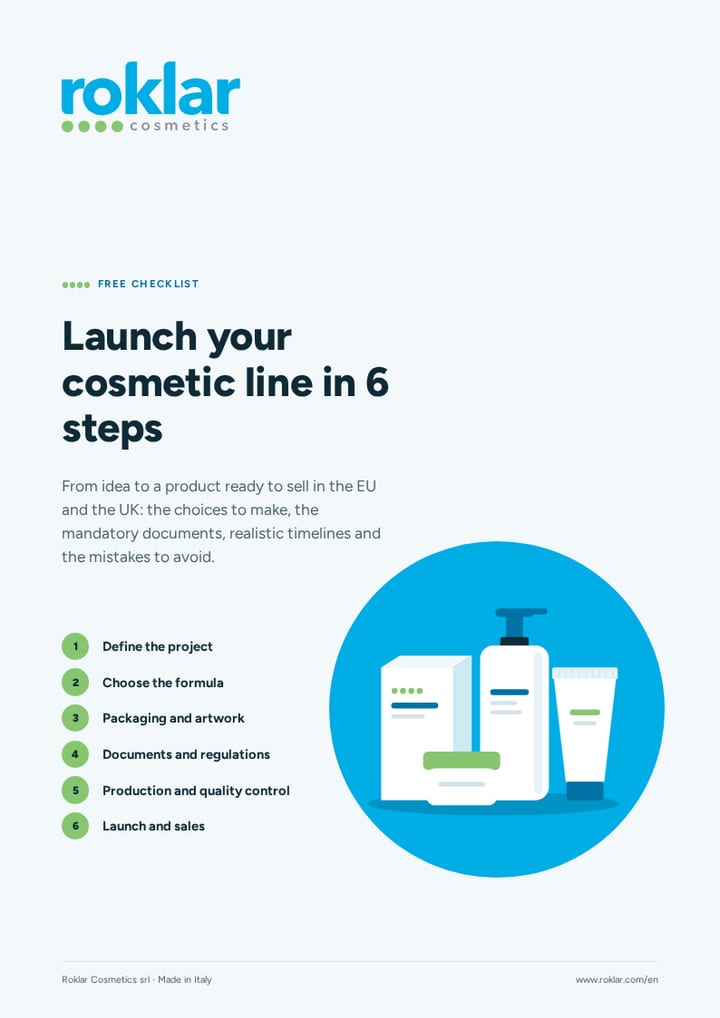
Free checklist
Choices, mandatory documents, realistic timelines and mistakes to avoid, in a 4-page PDF. What's inside